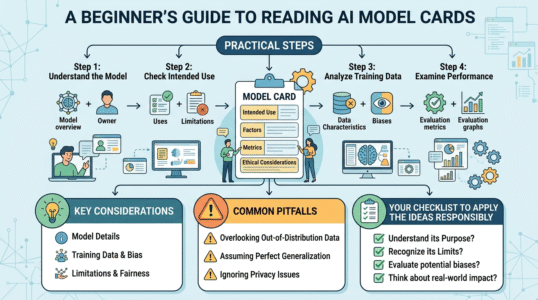
This guide to a beginner’s guide to reading ai model cards explains the core concepts, practical decisions, and common mistakes to watch for. Use the steps below as a starting point, then verify details against the tools and requirements in your own workflow.
Start with intended use
Check the tasks and user groups the model was designed for, along with prohibited or unsupported uses. A general-purpose model may still have gaps in specialist terminology, multilingual work, or long-document reasoning. Intended use gives context to every score that follows.
Interpret evaluations carefully
Look at the benchmark names, sample sizes, prompts, tools, and whether the evaluation was run by the developer or an independent group. If a model card reports only a single aggregate score, seek task-level detail before making a purchase or deployment decision.
Turn limitations into tests
Convert stated weaknesses into a small test set drawn from your real workflow. Include normal requests, edge cases, adversarial inputs, and examples where the model should refuse or admit uncertainty. Re-run the tests when you change the model or prompt.
Practical checklist
Keep a short evaluation record so future model updates can be compared against the same baseline.
Editorial note: This educational guide explains general methods and does not claim independent product testing. Check official documentation for current features, pricing, and terms before making decisions.