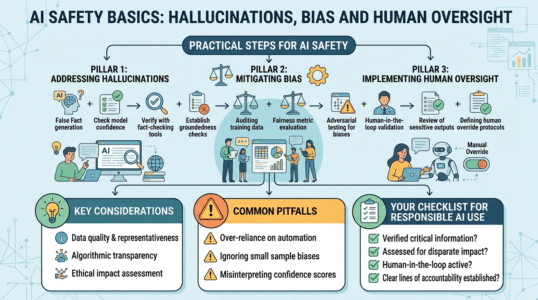
This guide to ai safety basics: hallucinations, bias and human oversight explains the core concepts, practical decisions, and common mistakes to watch for. Use the steps below as a starting point, then verify details against the tools and requirements in your own workflow.
Understand hallucinations and uncertainty
A language model can produce a confident answer that is unsupported or wrong. Ask for evidence, check citations by opening the sources, and use trusted records for facts that affect money, health, law, or safety. A fluent explanation is not proof of correctness.
Look for uneven performance
Systems may perform differently across languages, accents, populations, and unusual cases. Test with representative examples, document failures, and give users a clear way to challenge or correct an output. Avoid using demographic proxies as shortcuts for consequential decisions.
Build human review into the workflow
Human oversight works best when reviewers have time, context, and authority to reject an output. A rubber-stamp approval process adds little protection. Define which decisions can be automated, which need a second check, and when the system must stop and ask for help.
Practical checklist
Use least-privilege access, minimize personal data, log important actions, and measure error rates after deployment.
Editorial note: This educational guide explains general methods and does not claim independent product testing. Check official documentation for current features, pricing, and terms before making decisions.